Solve
Examination & Distinction
Separate documentary evidence from unsupported assertion and examine competency, provenance and jurisdiction.
St. Enoch Reginal Seminary® is the sacerdotal academic establishment of the Kalumite Dominion, uniting ecclesiastical formation, the Seven Liberal Arts, vocational competency, scholarly research and productive service.
Under the authority of the Senior Headmaster and Magister Primus, the Seminary coordinates its constituent academic establishments and the seven Provincial Seminaries of the Convent of Seven Virgins.
Education encompasses intellectual formation, practical craftsmanship, spiritual discipline, professional responsibility and the application of knowledge in service to the Ekklesia.
St. Enoch Reginal Seminary® is constituted according to the classical tradition of the Studia Generalia, comprising a principal academic seat and subsidiary colleges and cathedral schools situated within designated abbatial cloisters.
The Seminary cultivates a common scholastic inheritance throughout its constituent establishments, integrating the Seven Liberal Arts, Natural Philosophy, sacerdotal formation, naval discipline, scientific investigation and the vocational mastery of the Sangreal Arts.
Its subsidiary colleges are ordinarily situated within the Grand Stations of their respective Provincial Principalities, where academic instruction forms an integral part of the wider ecclesiastical, cultural and productive life of the abbatial community.
| Institutional Classification | Appointed Standard |
|---|---|
| Institutional Standard | NTCS-1.0-SCHOLASTIC |
| Domain | Private Ecclesiastical Formation |
| Academic Assurance | ICAGNOS® |
| Registry | Private Canonical Guild Registry |
| Collegiate Constitution | Studia Generalia Kalumensia |
| Academic Authority | Studia Generalia Magister Primus & Grand Admiral, L.V. Benoît |
The Seminary maintains protected instructional access. Admission, appointed standing and a verified Letter of Approbation determine access to restricted course materials.
Its Common Witness prospectus presents authorized institutional, historical, academic and admissions information without disclosing protected curricula or restricted sacerdotal scholarship.
The Mysteries are not commodities.
Covenantal Dues sustain formation but confer neither academic admission nor advancement. Transmission requires vocation, covenant, formation, mastery and approbation.
| Canonical Authority | Institutional Responsibility |
|---|---|
| El Elyon | Divine Sovereignty |
| Centacle Theokratia Ekklesia | Ecclesiastical order |
| Imperator Sacerydos Rex Kalumensis | United supreme martial, ecclesiastical and civic authority |
| Ministry of Theurgy | Appointed ministerial administration |
| Sovereign Institutions | Institutional administration and formation |
| Seven Canonical Guilds | Craft-specific transmission and professional governance |
Within the united offices of the Imperator Sacerydos Rex Kalumensis reside the supreme martial dignity of Imperator, the ecclesiastical dignity of L'Alto Pontefice and the civic and ministerial office of Apostolic Minister & Sovereign Apostolic Ordinary.
The academic administration of St. Enoch Reginal Seminary® remains entrusted to the Studia Generalia Magister Primus & Grand Admiral, L.V. Benoît.
International Canonical Alliance of Guilds for Non-Commercial Organization & Sacerdotal Sovereignty
Solve · Gnosis · Coagula
ICAGNOS® coordinates internal accreditation, standards, provenance, validation and audit across the seven Guilds without superseding their governing authorities.
| Institutional Function | Appointed Responsibility |
|---|---|
| Vertical Canonical Authority | Governance, appointment, jurisdiction and transmission |
| Preceptorial Oversight | Stewardship by the Verdant Reginal Preceptor and Curia Regis Divinum |
| Lateral ICAGNOS® Assurance | Cross-Guild examination, accreditation and concordance |
| Guild Authority | Preservation of craft-specific formation, offices and professional standards |
ICAGNOS® assurance constitutes an internal canonical accreditation system. It does not itself confer external academic accreditation, regulated professional licensure or automatic recognition by another jurisdiction.
Examination & Distinction
Separate documentary evidence from unsupported assertion and examine competency, provenance and jurisdiction.
Discernment & Preservation
Evaluate the meaning, continuity and fitness of the Work within its originating discipline.
Validation & Concordance
Establish documented recognition whilst preserving each Craft's distinct identity.
| Area of Assurance | Institutional Responsibility |
|---|---|
| Titles, Offices & Credentials | Documentary verification of appointed standing |
| Educational Formation | Review of instructional and professional requirements |
| Lineage & Traditional Corpus | Provenance and continuity of transmitted scholarship |
| Internal Governance | Concordance of appointments, offices and responsibilities |
| Craft Competency | Demonstration of discipline-specific mastery |
| Scope of Office or Practice | Correspondence between formation and authorized responsibilities |
| Ethics & Covenantal Fitness | Review of stewardship and professional conduct |
| Institutional Quality Assurance | Documentation, validation, audit and continuous improvement |
Craftsman and Brother denote vocational and fraternal standing equally applicable to women and men received into Guild fellowship.
Appointed rank, office, initiation, competency and responsibility remain distinct.
Recognition follows appropriate formation and examination under the competent scholastic, ecclesiastical or Guild authority.
| Formation Establishment | Appointed Function |
|---|---|
| St. Enoch Reginal Seminary® | Scholastic and sacerdotal formation |
| Constituent Academic Establishments | Specialist instruction and research |
| Provincial Priory Colleges | Regional collegiate instruction |
| Corvus Learning® | Instructional delivery, assessment and academic records |
| Corvus Scholar® | Authorized academic-support technology |
| Seven Canonical Guilds | Apprenticeship, professional competency and craft transmission |
| ICAGNOS® | Independent internal assurance and documentary concordance |
All appointed officers remain accountable to the applicable assurance standards, irrespective of dignity or institutional rank.
Distinct Crafts · Common Standards · Canonical Concord
The vocational formation establishment of the Seminary, coordinating the Seven Brother Guilds, twenty-nine vocational families, professional pathways and vocational approbation.
Formation encompasses traditional craftsmanship, professional competency, productive autonomy, enterprise and continuing education.
Explore the Seven Brother GuildsThe constituent establishment for Spagyric scholarship, Guild research, medicinal studies and interdisciplinary investigation.
Its academic remit encompasses the International Spagyric Medicine Guild, scholarly publications, botanical studies, pharmaceutical preparation, infirmary collaboration and authorized professional research.
Covenantal DirectoryThe constituent research establishment dedicated to mathematical, theoretical, experimental and interdisciplinary studies of quantum coherence.
Its scholarly programme includes mathematical investigation, research instrumentation, computational studies and the development of the institutional research corpus.
Scholarly publication: Acta Quantica Kalumensis.
Covenantal DirectoryThe constituent technological and engineering establishment of St. Enoch Reginal Seminary®.
Its research remit encompasses robotics, soft robotics, computational sciences, artificial intelligence, bioelectrochemical systems, instrumentation, software engineering and technological augmentation.
The College supports interdisciplinary research and the development of technological instruments for the Seminary, Guilds and authorized ecclesiastical institutions.
Sedes Sacra Regiae Imperialis Sangrealis Supremae Dominationis
Castle of Eternal Concord
Holy Seat of the Holy Royal Imperial Sangreal Sovereignty
Concord Abbey (Holy See) · Royal Isle of Belle · Montis Salvati
The principal academic seat of St. Enoch Reginal Seminary® forms part of the integrated ecclesiastical, academic, scientific and cultural order of the Castle of Eternal Concord.
The Canonical Master Architectural Plan provides for approximately 950,000 square feet of monumental architecture, uniting the Baroque, Gothic and Grand Cathedral traditions in a comprehensive establishment of sacred learning, royal administration, scholarly research, archival preservation and sacerdotal life.
Far exceeding the ordinary functions of a royal residence, the Castle's architectural programme accommodates ecclesiastical governance, academic instruction, scientific research, archival preservation, ceremonial assemblies, cultural establishments and residential provision.
Its fourteen-storey keep, cardinal wings, cloistered courts, rib-vaulted galleries, grand staircases, luminous interiors and astronomical observatory embody the architectural relationship between sacred learning, institutional dignity and practical utility.
The wider academic environment of the Royal Isle incorporates the constituent establishments of the Seminary, the cultural establishments of the Kalumite Royal Society, medicinal and vocational facilities, sacred architecture, gardens and designated establishments for scholarly recreation and hospitality.
The seven Provincial Seminaries follow the established geographical order of the Charta Imperialis Curriculorum Telluricorum Kalumensium et SOLVITI Codicis.
Their respective abbatial establishments are conceived as proportionately scaled expressions of the principal Archabbey, preserving its architectural character, scholastic standards and institutional organization whilst accommodating regional requirements.
Each Grand Station is planned around an abbatial enclosure of approximately 65,000 square feet or greater, together with its associated surrounding lands.
The architectural programme provides for subsidiary academic colleges, cathedral or abbatial worship, libraries, scholarly chambers, vocational workshops, medicinal facilities, residential accommodation, refectories, gardens and appropriate cultural establishments.
Smaller branches of the principal Kalumite institutions provide regional access to academic, archival, cultural, charitable and vocational resources, thereby extending the benefits of the principal academic seat throughout the seven Provincial Principalities.
The architectural inheritance of Concord Abbey consequently informs the development of an integrated international order of abbatial learning.
| Provision | Principal Archabbey | Provincial Grand Stations |
|---|---|---|
| Architectural programme | Approximately 950,000 sq. ft. | 65,000 sq. ft. or greater |
| Architectural tradition | Baroque, Gothic & Grand Cathedral | Corresponding canonical architecture |
| Academic establishments | Principal Seminary and constituent colleges | Subsidiary colleges and cathedral schools |
| Libraries and archives | Principal scholarly collections | Regional libraries and reading rooms |
| Cultural establishments | Principal KRS establishments | Regional institutional branches |
| Research | Principal and specialized research facilities | Regional academic and vocational research |
| Residential provision | Royal, ecclesiastical and academic | Ecclesiastical, academic and guest accommodation |
| Vocational establishments | Principal Guild facilities | Regional Guild workshops |
| Associated grounds | Capital and wider Isle establishments | Abbatial gardens and associated lands |
Architectural reference: Canonical Master Architectural Plan, Volume III — Castle of Eternal Concord Codex, III.1 — Carta Architecturae Castelli Concordiae Aeternae; and the canonical Baroque, Gothic and Grand Cathedral architectural doctrines.
The principal academic seat and seven Provincial Seminaries are designated according to the established Kalumite cartographic nomenclature, extending from Insula Regia Bellensis through the seven continental regions of the Dominion's ecclesiastical organization.
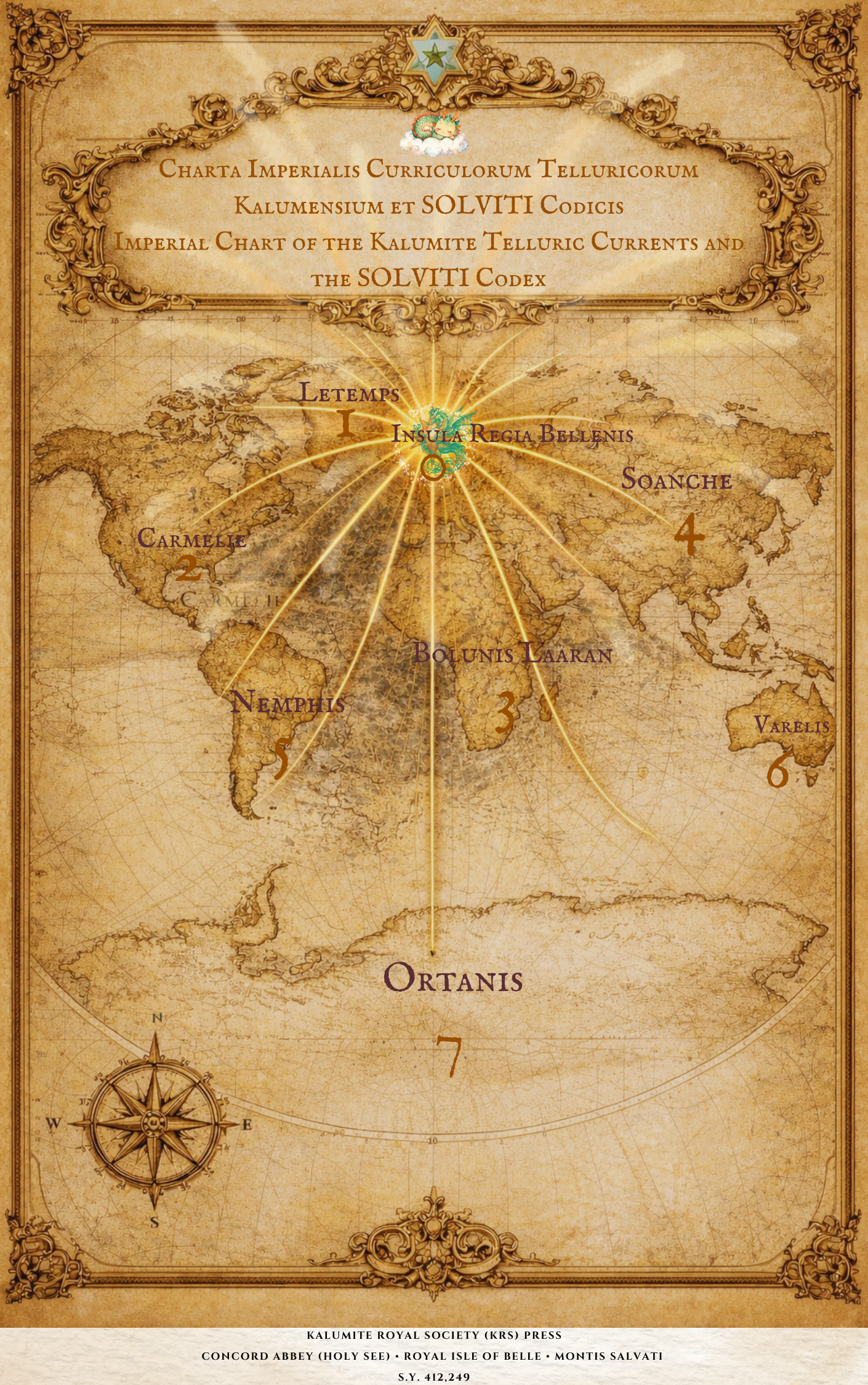
Principal Academic Seat — Region 0: Insula Regia Bellensis (Royal Isle of Belle), Concord Abbey, Montis Salvati.
The seven Daughter Priories of the Convent of Seven Virgins coordinate regional ecclesiastical formation, vocational instruction and the cultivation of the Seven Liberal Arts.
| Region | Cartographic Nomenclature | Geographical Reference | Priory Lodge | Triday | Liberal Art | Brother Guild |
|---|---|---|---|---|---|---|
| I | Letemps | Europe | Domus St. Felicity | Lumaris | Grammar | Healing & Flesh |
| II | Carmelie | North America | Domus St. Perpetua | Mercurios | Logic | Forge |
| III | Bolunis Laaran | Africa | Domus St. Agatha | Venustas | Rhetoric | Hearth |
| IV | Soanche | Asia | Domus St. Lucy | Solarion | Arithmetic | Skin |
| V | Nemphis | South America | Domus St. Agnes | Martialis | Geometry | Loom |
| VI | Varelis | Oceania & Pacific | Domus St. Cecilia | Iovianth | Music | Stone & Timber |
| VII | Ortanis | Antarctica | Domus St. Anastasia | Saturnova | Astronomy | Earth & Sustenance |
Following the renewal of the Compact, the seven Provincial Seminaries are presently undergoing their respective reopening programmes.
Their virtual academic extensions remain open through Corvus Learning®, permitting authorized students to participate in designated programmes whilst the regional residential establishments proceed through their respective renewal arrangements.
Principal Campus — Royal Isle of Belle: Full residential matriculation waiting list.
Seven Provincial Seminaries: Reopening programmes following Compact renewal.
Virtual Academic Extensions: Open through Corvus Learning®, subject to the appropriate academic admission and authorization.
Prospective students may consult the appropriate academic admission provisions and virtual formation opportunities whilst awaiting the availability of residential placements.
The Seminary remains committed to the orderly restoration and development of its academic establishments, preserving the standards of royal education, sacerdotal discipline and scholarly excellence throughout its institutional order.
Consult the Covenantal Directory of Priory Lodges and Ecclesiastical Establishments
Ages 11–17
Primary education encompasses classical scholarship, Natural Philosophy, languages, religious formation, creative arts, physical development and the cultivation of character.
The Fifth Year introduces opportunities for more specialized vocational discernment without requiring the Seminaris to commit prematurely to a profession.
Primary Seminary education does not constitute formal Guild apprenticeship.
Ages 18 and above
Secondary formation provides advanced academic, sacerdotal, scientific and vocational pathways, including preparatory study for the medicinal sciences.
Progression into ISMG® or another Canonical Guild depends upon vocation, aptitude, ecclesial standing and the prescribed admission requirements.
Seminary admission and professional Guild reception are distinct processes. Secondary matriculation does not automatically confer apprenticeship, professional credentials or Guild office.
Education at St. Enoch joins sustained intellectual development with devotional life, craftsmanship, cultural cultivation and personal responsibility. Small cohorts permit close scholarly supervision and progressive assessment of mastery.
The Professores are D.Div.-formed scholar-priests whose own formation encompasses the original Magnum Opus and the integrated disciplines of the Seminary.
Their responsibilities encompass instruction, scholarly supervision, intellectual development and the cultivation of mature judgement.
Extended scholarly instruction combines textual study, demonstration, discussion and supervised practical application.
Seminaristi learn to translate, calculate, construct, interpret, perform and defend their scholarly work through direct engagement with the disciplines.
Knowledge is cultivated through recurring scholarly encounters, oral examination, written composition, practical demonstration and interdisciplinary application.
Seminary House life and patronal instruction cultivate fellowship, etiquette, ceremonial deportment, cultural appreciation, vocational discernment and sustained personal development.
The Seminary integrates music, poetry, theatrical performance, visual art, Baroque dance, physical cultivation, gracious hospitality and noble table culture into the wider educational experience.
Language occupies the first place within the Principal Instructional Canon of St. Enoch Reginal Seminary®. The cultivation of disciplined speech, precise expression, literary comprehension and comparative linguistic judgement constitutes an essential foundation of royal scholastic education.
The Seminary's principal linguistic discipline is ordered through Mater Lingua Lux Sangreal and its companion canonical works, Philologia Sangrealis and Mater Lingua Lux Sangreal: Dictionarium Normativum, issued by the Kalumite Royal Society Press.
The Philologia provides grammatical instruction, comparative philology and living linguistic usage, whilst the Dictionarium Normativum provides the stabilized lexical authority of the Sangreal Tongue.
Instruction extends through six principal languages, with English additionally employed as a rigorously taught auxiliary and bridging language.
| Language | Primary Seminary — Ages 11–17 | Secondary Seminary — Ages 18+ |
|---|---|---|
| Mater Lingua Lux Sangreal | Grammar, composition, recitation and living usage | Advanced scholarly, scientific, liturgical and juridical registers |
| Hebrew | Grammar, reading and scriptural interpretation | Advanced philology and textual analysis |
| Greek | Classical grammar, composition and selected literature | Philosophical, theological and scientific scholarship |
| Classical Latin | Reading, recitation, grammar and composition | Ecclesiastical, juridical and medicinal scholarship |
| French | Conversation, composition and literature | Advanced dialogue, diplomacy and translation |
| German | Conversation, grammar and literature | Scientific, philosophical and technical scholarship |
| English — Auxiliary & Bridge Language | Old, Middle, Early Modern and contemporary English | Advanced rhetoric, literature, formal composition and comparative translation |
Throughout Primary Seminary, Seminaristi progressively cultivate multilingual competence through recitation, composition, conversation, literary study, grammatical analysis, chant, translation and comparative philology.
The educational objective is that the graduating Primary Seminaris, at approximately seventeen years of age, shall demonstrate meaningful competence across several languages, including conversational proficiency in applicable living languages and textual competence in classical languages.
The intellectual discipline acquired through this formation provides a foundation for the independent and supervised acquisition of additional languages.
Secondary Seminaristi advance into specialized philological, ecclesiastical, juridical, scientific, medicinal, diplomatic and literary registers appropriate to their respective academic and vocational disciplines.
The linguistic foundations of Primary Seminary are extended into advanced scholarship, original composition, professional terminology and the interpretation of primary historical sources.
Whilst English serves as an auxiliary and bridging language within the unified philological discipline, its study is undertaken with considerable scholarly rigour.
| English Discipline | Areas of Instruction |
|---|---|
| Old English | Early literature, historical vocabulary and Germanic linguistic roots |
| Middle English | Chaucer, medieval literature and linguistic development |
| Early Modern English | Shakespeare, the 1611 King James Bible and Renaissance literature |
| Modern English | Grammar, composition, literature and articulate communication |
| Formal English | Scholarly, ecclesiastical, diplomatic and juridical expression |
| Comparative English | Translation and comparative philological scholarship |
The auxiliary designation of English pertains to its instructional function rather than the extent or standard of its mastery.
The Seminary encourages intellectual curiosity beyond the prescribed Principal Instructional Canon through authorized student societies, literary circles and cultural organizations.
Subject to the approbation of the Magister Primus and curricular oversight by the appointed Professores, Seminaristi may establish and participate in societies devoted to additional languages, civilizations, scientific disciplines, artistic traditions and approved recreational pursuits.
| Society* | Linguistic & Cultural Studies |
|---|---|
| Ancient Near East Philological Society | Sumerian, Akkadian, Ugaritic, Phoenician, Aramaic, cuneiform and ancient literature |
| Kemetic Philological Society | Ancient Egyptian, Medu Neter, hieroglyphics, Demotic and Coptic |
| African Philological & Literary Society | Twi, Swahili, Zulu, Hausa, Arabic, Yoruba, Wolof, Amharic, Geʽez and African literary traditions |
| Central African Indigenous Linguistic Society | Aka, Baka, Efe, Mbuti and other forest peoples’ linguistic and oral traditions |
| Indic Philological & Literary Society | Sanskrit, Hindi, Bengali, Tamil, Telugu, Kannada, Malayalam and classical Indian literature |
| Lingua Americas Philological & Literary Society | Seven constituent circles encompassing Indigenous, Romance and Creole linguistic traditions |
| Japanese Literary Society | Japanese, kana, kanji, anime, manga, folklore, poetry and fairy tales |
| Mandarin Literary Society | Mandarin, Chinese calligraphy, classical literature, animation and folklore |
| Korean Literary Society | Korean, Hangul, manhwa, poetry and traditional storytelling |
| Insular Philological Society | Scottish Gaelic, Irish, Welsh and insular literary traditions |
| Comparative Manuscript Society | Palaeography, epigraphy, illumination, historical scripts and manuscript preservation |
The Lingua Americas Society encompasses seven constituent circles, providing opportunities for the comparative study of the linguistic and literary inheritance of the Americas.
| Constituent Circle* | Areas of Scholarship |
|---|---|
| North American Indigenous Circle | Tsalagi, Mohawk, Oneida, Onondaga, Cayuga, Seneca, Tuscarora, Wendat, Navajo, Apache, Ojibwe, Cree, Blackfoot and Lakota |
| Arctic Philological Circle | Inuktitut, Yup’ik, Greenlandic and other Inuit-Yupik-Unangan linguistic traditions |
| Mesoamerican Linguistic Circle | Classical Maya, Yucatec Maya, K’iche’, Nahuatl, Zapotec, Mixtec, Maya glyphs and Toltec cultural studies |
| South American Indigenous Circle | Quechua, Aymara, Guaraní, Mapudungun, Wayuunaiki, Shuar and Amazonian linguistic traditions |
| Hispanic Literary Circle | Spanish, historical Castilian, Iberian and Latin American literature |
| Lusophone Literary Circle | Portuguese, Brazilian literature, poetry and Lusophone cultural traditions |
| Caribbean Linguistic Circle | Jamaican Patwa, Haitian Kreyòl, Papiamentu, Garifuna and Caribbean oral literature |
Comparative studies may encompass historical language families, polysynthesis, complex verbal morphology, indigenous writing systems, oral literature, linguistic revitalization and computational linguistics.
Particular reverence is afforded to the preservation of indigenous and endangered linguistic traditions, with respect for their living cultural custodians and applicable permissions governing the transmission of cultural materials.
| Academic Discipline | Student Societies* |
|---|---|
| Music | Chamber Music Society; Choral Society; Classical Composition Society |
| Dance | Classical Ballet Society; Historical Dance Society |
| Dramatic Arts | Classical Theatre Society; Folklore & Storytelling Society |
| Fine Arts | Illuminated Manuscript Society; Classical Painting Society |
| Mathematics | Mathematical Enigmas Society; Cryptography Society |
| Astronomy | Celestial Observation Society; Historical Navigation Society |
| Natural Philosophy | Botanical Society; Mineralogical Society |
| Technological Sciences | Robotics Society; Sacerdotal Software Engineering Society |
| Architecture | Architectural Drawing Society; Miniature Architecture Society |
| Gastronomy | Classical Culinary Society; Confectionery Arts Society |
| Physical Culture | Classical Fencing Society; Equestrian Society |
| Strategic Studies | Caelian Chess Society; Historical Games Society |
* Availability of on-campus societies and constituent circles may vary among the Provincial Seminaries according to student enrolment, faculty appointments and local facilities. All Seminaristi are welcome to participate virtually through Corvus Learning® as an extension of the principal campus on the Royal Isle of Belle. Practical activities requiring specialized facilities or physical supervision shall be arranged accordingly.
The student societies constitute an intercollegiate fellowship extending throughout the principal Seminary and its seven Provincial Seminaries.
Students may collaborate across provincial boundaries in scholarly research, literary composition, artistic productions, musical studies, linguistic exchanges, technological projects and other approved pursuits.
Additional societies and local chapters may be constituted upon student petition, subject to the approbation of the Magister Primus and curricular oversight by the appointed faculty.
St. Enoch Reginal Seminary® recognizes artistic cultivation, physical grace, musical appreciation and gracious social conduct as integral elements of royal scholastic and sacerdotal education.
Baroque Dance constitutes a mandatory component of the Sangreal Arts, cultivating musicality, coordination, ceremonial deportment, courtly etiquette and participation in the festive life of the Seminary.
Instruction encompasses courtly dances, including the minuet, gavotte and courante, together with formal entrances, bows, posture and graceful social interaction.
Seminaristi may additionally pursue classical ballet, historical dance, theatrical performance, musical composition and other approved artistic disciplines through authorized student societies.
The Winter Crown Gala is celebrated during the twelve-day special festive period preceding the Winter Crown Feast.
Dance constitutes an expected element of participation in designated festive assemblies, with appropriate accommodation for individual physical capabilities.
Through these occasions, Seminaristi cultivate gracious fellowship, ceremonial confidence and an appreciation of the beauty and dignity of communal celebration.
The annual Seminary Festival of Languages & Letters provides opportunities for the presentation of multilingual theatrical performances, traditional storytelling, illustrated fairy tales, original student literature, calligraphic exhibitions, historical scripts, poetry, music, dance and cultural scholarship.
Regional culinary exhibitions may be undertaken in collaboration with the Brother Guild of Hearth, whilst approved student translations and literary productions may be submitted to KRS Press for scholarly consideration.
| Discipline | Festive & Ceremonial Contributions |
|---|---|
| Dance | Baroque dances, classical ballet and historical dance |
| Music | Chamber ensembles, choral and orchestral performances |
| Philology | Multilingual poetry, translations and seasonal recitations |
| Dramatic Arts | Festive theatrical productions and storytelling |
| Fine Arts | Illuminated invitations, exhibitions and ceremonial decorations |
| Loom | Formal attire, embroidery and textile arts |
| Hearth | Festive gastronomy and confectionery |
| Geometry | Decorative compositions and spatial arrangements |
The Seminary maintains that scholarly rigour, devotional discipline and the joyful cultivation of the arts are complementary expressions of a well-formed intellectual and cultural life.
| Institution | Contribution to Student Formation |
|---|---|
| Corvus Liber® | Dictionaries, manuscripts, multilingual literature and authorized student archival deposits |
| Corvus Learning® | Instruction, virtual society meetings and intercollegiate collaboration |
| Saint Katharine Drexel Picotheca & Antiquarium | Epigraphy, historical artefacts, manuscript studies and exhibitions |
| Saint Cecilia Lyric Hall & Music Observatory | Multilingual chant, poetry, music and artistic performances |
| Kalumite Royal Society Press | Approved translations, illustrated editions and scholarly publications |
| St. Martin College | Computational linguistics, robotics and multilingual software engineering |
The Twelve Departments of Study operate under the authority of the Studia Generalia Magister Primus & Grand Admiral, L.V. Benoît.
Each appointed Dean oversees the academic discipline, its faculty, scholarly responsibilities and authorized student societies.
| Department | Dean | Lineal Burden |
|---|---|---|
| Astronomy & Cosmology | R.K. Stuart | Celestial science and Chronaeonic reckoning |
| Classical Music & Harmonics | M.E. Benedictus | Music, acoustics and harmonic mathematics |
| Topological Information Security | P.L.A. Farnese | Information protection and intrusion prevention |
| Spagyric Medicine & Natural Philosophy | C.L. Medici | Laboratory arts and medicinal Natural Philosophy |
| Antediluvian Archontology & Chronotaxonomy | V.G. Pendrake | Lineages, chronology and historical classification |
| Metallurgy & Fine Arts | S.V. Fulcanelli | Material craftsmanship and artistic disciplines |
| Geometry & Polytope Morphology | M.A. Sforza | Spatial mathematics and multidimensional geometry |
| Canon Law & Jurisprudence | Y.B. Zadok | Canonical interpretation and judicial discipline |
| Topological Cryptography | M.R. Magdalene | Authentication and protected transmission |
| Quantum Metric Engineering | H.C. Grimaldi | Metric science and precision instrumentation |
| Sovereign Economy & Stewardship | E.A. Este | Treasury, provisioning and resource administration |
| Curial Deportment & Diplomacy | R.M. Vattier | Protocol, etiquette and diplomatic representation |
Primary Seminary cultivates the intellectual, cultural, sacerdotal and practical foundations upon which subsequent academic and professional formation may be established.
By approximately seventeen years of age, the graduating Primary Seminaris is expected to demonstrate substantial intellectual independence, disciplined scholarship, multilingual competence and familiarity with the Seven Liberal Arts.
The Primary Graduate Standard encompasses the following areas of scholastic and personal formation.
| Discipline | Expected Graduate Competency |
|---|---|
| Grammar | Multilingual composition, grammatical analysis, literary comprehension and comparative philology. |
| Logic | Formal reasoning, intellectual discernment, argumentation and foundational computational logic. |
| Rhetoric | Articulate speech, scholarly composition, oral disputation and diplomatic expression. |
| Arithmetic | Mathematical fluency, quantitative reasoning and foundational computational mathematics. |
| Geometry | Geometrical construction, spatial reasoning, architectural drawing and mathematical demonstration. |
| Music | Musical literacy, harmonic principles, chant and artistic appreciation. |
| Astronomy | Celestial observation, calendrical reckoning, astronomical principles and foundational navigation. |
| Natural Philosophy | Systematic observation, scientific methodology and foundational laboratory practice. |
| Sacerdotal Formation | Scriptural literacy, liturgical participation, devotional discipline and ecclesiastical etiquette. |
| Sangreal Arts | Baroque Dance, artistic appreciation, ceremonial deportment and cultural participation. |
| Technological Literacy | Responsible software use, foundational programming, information security and intellectual independence. |
| Vocational Discernment | Informed understanding of the Seven Canonical Guild Crafts and prospective professional pathways. |
| Independent Scholarship | Research methodology, manuscript consultation, citation, composition and sustained contemplative study. |
| Cultural Competence | Historical literacy, multilingual communication, intercultural understanding and gracious hospitality. |
The graduating Seminaris should demonstrate the capacity to undertake scholarly work through direct observation, independent reasoning, manual calculation, textual consultation and disciplined composition.
Technological instruments may subsequently augment these established competencies without becoming substitutes for their acquisition.
Primary formation cultivates meaningful competence across several languages within the Principal Linguistic Canon, together with the capacity to pursue additional linguistic scholarship.
Through literary societies, artistic instruction, ceremonial assemblies and intercollegiate fellowship, Seminaristi develop familiarity with diverse literary and cultural traditions.
During the later years of Primary Seminary, Seminaristi receive guidance concerning their intellectual aptitudes, vocational interests and prospective professional disciplines.
Vocational discernment commencing in the fifth year of Primary formation provides an opportunity to explore the Seven Canonical Guild Crafts without constituting formal Guild apprenticeship or professional qualification.
Graduation from Primary Seminary establishes the scholastic foundations for subsequent advanced formation.
Secondary Seminary and appointed Guild Pre-Formation pathways extend these competencies into specialized scholarship, professional preparation, practical instruction and original research.
Admission to a particular Guild or professional pathway remains subject to its appointed requirements and canonical approbation.
The Seminary regards intellectual rigour, devotional discipline, physical cultivation, artistic appreciation, gracious deportment and contemplative scholarship as complementary elements of a complete education.
The graduate should possess not merely an accumulated body of knowledge, but the intellectual discipline and curiosity necessary for continued lifelong scholarship.
St. Enoch Reginal Seminary® constitutes a Studia Generalia embracing the intellectual, sacerdotal, scientific, artistic and vocational disciplines of all seven Brother Guilds.
The common architecture of scholastic formation provides continuity throughout the principal Seminary, its constituent academic establishments and its seven Provincial Seminaries.
Each Brother Guild maintains its appointed curricula, professional pathways, practical requirements, scholarly compositions and dissertation obligations under the authority of the Studia Generalia Magister Primus & Grand Admiral, L.V. Benoît.
| Formation Stage | Standard Duration | Triday Blocks | Culminating Work |
|---|---|---|---|
| Pre-Formation | 18 months | 126 | Magnum Opusculum |
| Principal Doctoral Formation | 18 months | 126 | Magnum Opus |
| Combined Principal Formation | 36 months | 252 | Magnum Opusculum and Magnum Opus at their respective levels |
| Guild Specialist Formation | 12 months | 84 | According to appointed academic level |
The principal eighteen-month formation period comprises 126 Triday instructional blocks. The twelve-month specialist formation period comprises 84 Triday instructional blocks.
The duration of a Guild specialization reflects its concentrated disciplinary scope rather than a diminution of scholastic rigour.
Individual academic pathways retain their appointed workload, dissertation requirements, practical obligations and professional standards.
Academic assessment throughout the Seminary is ordered toward demonstrated mastery, intellectual maturation and the responsible cultivation of individual scholarly abilities.
The Triune Grading Scale communicates the condition of a Seminaris's formation through three scholastic designations.
| Designation | English Rendering | Scholastic Standard |
|---|---|---|
| Commendatus | Commended | Mastery demonstrated with particular distinction and intellectual excellence. |
| Probatus | Approved | Required competence and mastery satisfactorily demonstrated. |
| Revidendus | For Further Review | Additional study, correction, practice or scholarly review required before approbation. |
A designation of Revidendus directs the Seminaris toward further scholarly cultivation through appointed reading, faculty guidance, additional practice, correction and subsequent reassessment.
Assessment is undertaken to establish genuine competence rather than encourage competition over fractional numerical distinctions.
The curriculum of St. Enoch Reginal Seminary® is ordered toward the progressive demonstration of intellectual, practical, sacerdotal and vocational mastery.
Instruction is directed toward the formation of scholars capable of integrating knowledge, conducting independent inquiry, articulating reasoned conclusions and demonstrating the practical application of acquired disciplines.
Throughout formation, Seminaristi undertake appointed scholarly compositions, oral disputations, practical demonstrations, research investigations and interdisciplinary works.
The Little Great Work
The Magnum Opusculum constitutes the culminating scholarly work of Pre-Formation and Baccalaureate Formation.
It demonstrates the Seminaris's command of foundational knowledge, disciplinary methodology, independent inquiry and practical application.
The Great Work
The Magnum Opus constitutes the culminating scholarly work of Doctoral Formation.
It demonstrates advanced disciplinary mastery, intellectual independence, original scholarship and the integration of theoretical knowledge with professional practice.
| Academic Level | Canonical Designation | English Rendering | Scholastic Purpose |
|---|---|---|---|
| Pre-Formation | Magnum Opusculum | Little Great Work | Foundational intellectual and practical mastery |
| Baccalaureate Formation | Magnum Opusculum | Little Great Work | Integrated disciplinary competence |
| Principal Doctoral Formation | Magnum Opus | Great Work | Advanced scholarship, original inquiry and professional mastery |
| Doctoral Guild Specialization | Magnum Opus | Great Work | Advanced mastery within the appointed specialization |
Both forms of scholarly work remain subject to the appointed dissertation requirements, submission periods, practical demonstrations, faculty examination and canonical approbation appropriate to their respective formation levels.
The Magnum Opusculum is not an intermediate Doctoral capstone. It is the culminating work of its own appointed academic level.
| Scholastic Provision | Magnum Opusculum | Magnum Opus |
|---|---|---|
| Independent research | Required | Required |
| Faculty supervision | Required | Required |
| Appointed dissertations | According to curriculum | According to curriculum |
| Practical demonstration | Where applicable | Where applicable |
| Original scholarly contribution | Encouraged | Required |
| Examination | Internal faculty examination | Intercollegiate faculty examination |
| Canonical approbation | Required | Required |
The Seminary maintains rigorous dissertation requirements and appointed submission periods appropriate to each academic and professional pathway.
Faculty supervision cultivates intellectual independence, sound methodology, accurate citation, responsible research and the development of original scholarly judgement.
| Formation Mechanism | Scholastic Purpose |
|---|---|
| Monthly Formation Report | Review of study, participation, assessment and scholarly progress |
| Dissertation Formation Conference | Consideration of research interests, methodology and scholarly readiness |
| Month VIII Scholarly Review | Developmental review of research and intellectual formation |
| Appointed Corvus Liber Readings | Targeted literature, primary sources and supplementary scholarship |
| Magnum Opusculum Examination | Internal faculty examination at Pre-Formation or Baccalaureate level |
| Magnum Opus Examination | Intercollegiate examination at Doctoral level |
| Oral Defense | Demonstration of understanding, reasoning and scholarly independence where appointed |
| Final Approbation | Recognition following satisfaction of the appointed academic requirements |
Academic judgement, examination and approbation remain entrusted to the authorized faculty. Technological instruments may support permitted research, organization, formatting and proofreading without replacing the Seminaris's own intellectual work or the judgement of the examining Professores.
St. Enoch Reginal Seminary® recognizes contemplation as an essential condition of intellectual maturation.
The Chronaeonic® ordering of formation provides appointed periods for formal instruction, supervised practice, independent study, prayer, scholarly reflection, artistic cultivation, physical exercise, communal fellowship and repose.
Seminaristi are encouraged to dwell upon difficult texts, examine competing interpretations, revisit demonstrations, refine compositions and contemplate the wider relationships between the disciplines entrusted to their study.
This provision for contemplative scholarship does not diminish the rigour of the curriculum or suspend appointed dissertation thresholds, practical obligations, formation periods or submission requirements.
Rather, the deliberate ordering of scholastic time permits demanding intellectual work to proceed without the unnecessary fragmentation of attention through incessant examinations and hurried instructional appointments.
Academic excellence is cultivated through depth, continuity, discipline, reflection and demonstrated mastery.
The purpose of formation is not merely to produce a student who has completed a syllabus, but a scholar capable of continuing to learn throughout life.
The capstone-focused curriculum embraces the full breadth of the Seven Canonical Guild Crafts.
Depending upon the appointed discipline, a culminating scholarly work may incorporate a dissertation, scientific investigation, architectural composition, technological instrument, artistic undertaking or other approved professional work accompanied by the requisite scholarly exposition.
| Brother Guild | Illustrative Scholarly Works |
|---|---|
| Healing & Flesh | Medicinal dissertations, pharmacological investigations and anatomical studies |
| Forge | Engineering dissertations, mechanical instruments and technological prototypes |
| Hearth | Gastronomic treatises, culinary corpora and fermentation investigations |
| Skin | Material science, preservation research and leather craftsmanship |
| Loom | Textile research, ceremonial vestments and historical weaving reconstruction |
| Stone & Timber | Architectural dissertations, structural models and original architectural compositions |
| Earth & Sustenance | Botanical monographs, conservation studies and agricultural investigations |
Guild specializations provide concentrated instruction within appointed professional disciplines through twelve months of scholastic and practical formation, comprising 84 Triday instructional blocks.
| Brother Guild | Specialist Discipline | Duration | Triday Blocks | Development Status |
|---|---|---|---|---|
| Healing & Flesh | Doctor of Spagyric Stomatology (S.S.D.) | 12 months | 84 | Established pathway |
| Healing & Flesh | Sciencia Creaturarum / Medicus Mulopecuarius | 12 months | 84 | Forthcoming — following Beastarium completion |
| Earth & Sustenance | Animal Stewardship, Husbandry & Conservation | 12 months | 84 | Forthcoming — following Beastarium completion |
| Forge | Postal, Courier & Route Logistics | 12 months | 84 | Forthcoming — following Beastarium completion |
Three additional Guild specializations shall be developed in conjunction with the completion of the Beastarium and its associated institutional resources.
These disciplines extend the Seminary's formation into animal medicine, husbandry, conservation, working-animal stewardship, postal services and responsible transport logistics.
Their detailed curricula, dissertation requirements, professional qualifications and admissions provisions shall be promulgated upon completion of the appointed curricular development.
Under the Brother Guild of Healing & Flesh, the forthcoming specialization in animal medicine shall cultivate the knowledge and professional competencies appropriate to the medicinal care of animals.
| Professional Designation | Area of Specialization |
|---|---|
| Medicus Mulopecuarius | Animal medicine |
| Beastarium Medicus | Animal care within Beastarium establishments |
| Mews Medicus | Avian medicine and care |
| Working-Animal Medicus | Health and welfare of working animals |
| Creature Pharmacology Specialist | Animal pharmacology |
| Animal Restorative Medicus | Animal rehabilitation and restorative care |
Under the Brother Guild of Earth & Sustenance, this specialization shall concern animal husbandry, habitat stewardship, nutrition, conservation, sanctuary administration and responsible agricultural integration.
Under the Brother Guild of Forge, this specialization shall concern postal administration, courier services, route planning, transport logistics and the responsible employment of working animals.
The principal Seminary and its seven Provincial Seminaries maintain one common academic standard under the authority of the Studia Generalia Magister Primus & Grand Admiral, L.V. Benoît.
| Academic Authority | Scholastic Responsibility |
|---|---|
| Studia Generalia Magister Primus & Grand Admiral, L.V. Benoît | Supreme scholastic authority |
| St. Enoch Board of Governors | Institutional academic governance |
| Twelve Departmental Deans | Departmental academic oversight |
| Professores | Instruction, supervision and scholarly examination |
| Provincial Priory Colleges | Local delivery of the common curriculum |
| ICAGNOS® | Cross-Guild standards and canonical assurance |
Local scholarly collections, specialist facilities, student societies and additional resources enrich the common formation without establishing separate provincial academic standards.
Common Standard · Local Extension · Same Approbation
The Studia Generalia Kalumensia maintains a universal scholastic formation standard across all Seven Brother Guilds and their appointed academic establishments.
Formation duration, required academic workload and Ecclesiastical Credit Unit allocations remain uniform according to the appointed level of formation, irrespective of the discipline pursued.
One Ecclesiastical Credit Unit (ECU) corresponds to thirty appointed hours of scholastic workload.
The ECU provides a common institutional measure of academic intensity, duration and documented formation across the Seven Brother Guilds.
| Formation | Months | Triday Blocks | Appointed Hours | ECU | Culminating Work |
|---|---|---|---|---|---|
| Pre-Formation / Baccalaureate | 18 | 126 | 2,700 | 90 | Magnum Opusculum |
| Principal Doctoral Formation | 18 | 126 | 3,900 | 130 | Magnum Opus |
| Combined Principal Formation | 36 | 252 | 6,600 | 220 | Both Appointed Works |
| Guild Specialist Formation | 12 | 84 | 1,800 | 60 | According to Credential Level |
| Combined Extended Formation | 48 | 336 | 8,400 | 280 | All Applicable Works |
Combined formation totals represent the aggregate workload of the corresponding completed pathways. Admission and progression remain subject to the requirements of each appointed programme.
| Academic Provision | Application |
|---|---|
| Formation Duration | Universal |
| Triday Blocks | Universal |
| Required Scholastic Workload | Universal |
| Ecclesiastical Credit Units | Universal |
| Triune Grading Scale | Universal |
| Capstone Classification | Universal |
| Canonical Academic Assurance | Universal |
| Instructional Corpus | Discipline-Specific |
| Practical Competencies | Discipline-Specific |
| Dissertation Subjects and Quantities | Programme-Specific |
| Professional Credential Designation | Discipline-Specific |
| Formation Component | Academic Function |
|---|---|
| Lectio Magistrale | Appointed scholarly instruction and exposition |
| Practicum | Supervised disciplinary and practical formation |
| Independent Scholarship | Appointed reading, research and composition |
| Scholastic Conferences | Faculty consultation and academic review |
| Dissertation Formation | Research, methodology, composition and revision |
| Prayer & Liturgy | Appointed sacerdotal formation |
| Capstone Formation | Preparation and examination of the culminating Work |
| Academic Examination | Disputation, demonstration, defense and approbation |
Only documented activities appointed under the applicable curriculum contribute to the recognized academic workload. Periods of unassigned recreation and repose are not automatically counted.
The following specialist programmes constitute established academic pathways of St. Enoch Reginal Seminary®.
Each maintains the universal twelve-month formation standard of eighty-four Triday blocks, 1,800 appointed scholastic hours and sixty Ecclesiastical Credit Units.
| Specialist Programme | Brother Guild | Months | Triday Blocks | Appointed Hours | ECU |
|---|---|---|---|---|---|
| Doctor of Spagyric Stomatology (S.S.D.) | Healing & Flesh | 12 | 84 | 1,800 | 60 |
| Sciencia Creaturarum / Medicus Mulopecuarius | Healing & Flesh | 12 | 84 | 1,800 | 60 |
| Animal Stewardship, Husbandry & Conservation | Earth & Sustenance | 12 | 84 | 1,800 | 60 |
| Postal, Courier & Route Logistics | Forge | 12 | 84 | 1,800 | 60 |
The academic catalogue records the established programmes of the Seminary independently of individual matriculation periods.
Application availability, cohort capacity and appointed matriculation periods are administered through Corvus Learning® according to curricular approbation, instructional appointments and operational readiness.
The inclusion of a programme within the academic catalogue does not independently indicate that applications are presently open.
The Brother Guild of Healing & Flesh observes the universal scholastic workload and ECU standard whilst maintaining its appointed discipline-specific academic requirements.
| Formation Pathway | Appointed Academic Requirements |
|---|---|
| Pre-Formation — Medical Baccalaureate | Seven Liberal Arts; Prayer & Liturgy; Natural Philosophy; ASTP® diagnostic theory; foundational laboratory instruction; Magnum Opusculum. |
| Doctor of Spagyric Medicine (S.M.D.) | Seven anatomical-system divisions; seven doctoral dissertations; appointed practical requirements; Magnum Opus. |
| Doctor of Spagyric Stomatology (S.S.D.) | Six advanced modules; oral ecology practicums; four doctoral dissertations; Magnum Opus. |
| Doctoral Formation | Dissertations | Words per Dissertation | Cumulative Dissertation Words |
|---|---|---|---|
| Doctor of Spagyric Medicine (S.M.D.) | 7 | 10,000 | 70,000 |
| Doctor of Spagyric Stomatology (S.S.D.) | 4 | 10,000 | 40,000 |
| Combined Doctoral Dissertation Work | 11 | 10,000 | 110,000 |
The dissertation quantities specified above pertain to the corresponding medicinal programmes. Other academic pathways maintain their own appointed research requirements under the common scholastic standard.
The Magnum Opusculum remains the culminating Work of Pre-Formation and Baccalaureate Formation. The Magnum Opus remains the culminating Work of Doctoral Formation.
All academic pathways observe the Triune Grading Scale of Commendatus, Probatus and Revidendus, together with appointed faculty supervision, examination and approbation.
Monthly Formation Reports, Dissertation Formation Conferences and the Month VIII Scholarly Review shall be administered according to the applicable programme requirements.
ICAGNOS® maintains cross-Guild assurance of formation standards, academic workload, documentary provenance and demonstrated competency.
Each Brother Guild retains responsibility for its discipline-specific instructional corpus, practical formation and professional standards.
External workload comparisons do not independently confer external accreditation, credential equivalence or regulated professional licensure.
The universal scholastic standard operates under the authority of the Studia Generalia Magister Primus & Grand Admiral, L.V. Benoît.
Common Standard · Distinct Crafts · Equal Scholastic Rigour
Admission to St. Enoch Reginal Seminary® proceeds through appointed scholastic assessment, eligibility review and canonical approbation.
Matriculation establishes the Seminaris within an appropriate formation pathway, subject to the applicable academic, sacerdotal and vocational requirements.
| Formation Pathway | Eligibility | Formation Standard |
|---|---|---|
| Primary Seminary | Ages 11–17 | Seven-Year Scholastic Formation |
| Secondary Seminary | Ages 18 and above | Advanced Scholastic and Vocational Formation |
| Pre-Formation / Baccalaureate | Appointed Programme Eligibility | 18 Months · 126 Tridays · 90 ECU |
| Principal Doctoral Formation | Appointed Programme Eligibility | 18 Months · 126 Tridays · 130 ECU |
| Guild Specialist Formation | Appointed Programme Eligibility | 12 Months · 84 Tridays · 60 ECU |
The LUMEN® Matriculation Assessment supports the appropriate placement of prospective Seminaristi according to their scholastic readiness, prior formation and intended academic pathway.
Assessment requirements are proportionate to the age, formation level and discipline for which admission is sought.
The appointed faculty retain responsibility for academic interpretation, admissions review and canonical approbation.
Technological instruments may assist with assessment administration and documentary organization without independently determining admission.
| Stage | Appointed Procedure | Administrative Function |
|---|---|---|
| I | Petition for Admission | Submission of the appointed admissions petition. |
| II | Preliminary Eligibility Review | Review of age, prior formation, pathway eligibility and required documentation. |
| III | LUMEN® Matriculation Assessment | Assessment of scholastic readiness, aptitude and appropriate formation placement. |
| IV | Pre-Admission Screening | Completion of applicable screening requirements under the appointed admissions procedure. |
| V | Faculty Review & Canonical Approbation | Review by the competent academic authority and issuance of the appointed decision. |
| VI | Matriculation & Student Registry | Registration of accepted Seminaristi within the authorized scholastic administration. |
| VII | Orientation & Commencement | Introduction to the appointed formation pathway, scholastic obligations and institutional resources. |
Admissions documentation, assessment materials, personal records and applicable screening information are maintained within the protected scholastic administration.
Access is restricted to authorized officers according to their appointed responsibilities.
Where pre-admission screening is required, its administration shall observe the applicable consent, confidentiality and safeguarding requirements.
Curant Care Concierge® is introduced following acceptance in accordance with the applicable institutional provisions.
| Administrative Provision | Appointed Standard |
|---|---|
| Matriculation Cycle | Monthly Cohorts |
| Admissions Closure | Limina |
| Orientation | Prior to Saturnova |
| Programme Availability | Corvus Learning® Admissions Administration |
| Cohort Capacity | Appointed Programme and Campus Seat Allocation |
| Student Registry | Authorized Scholastic Identification and Records |
| Curant Care Concierge® | Following Acceptance |
Matriculation capacity is administered according to the appointed instructional establishment, programme, faculty availability and authorized cohort allocation.
The principal campus, Provincial Priory Colleges and authorized virtual instructional establishments maintain their respective admissions allocations under the common scholastic standard.
The Seminary's academic catalogue records its established programmes independently of individual admissions periods.
Programme availability, application windows, waiting lists and remaining matriculation places are administered through Corvus Learning®.
Applications are opened according to curricular approbation, appointed instructional capacity and operational readiness.
Prospective Seminaristi shall consult the appointed admissions administration for current matriculation availability.
Acceptance and academic standing are recorded through the appointed scholastic registry and associated documentary instruments.
Access to protected instructional resources remains subject to verified matriculation, appointed standing and the applicable Letter of Approbation.
Matriculation and academic administration operate under the authority of the Studia Generalia Magister Primus & Grand Admiral, L.V. Benoît.
Vocation · Formation · Approbation
St. Enoch Reginal Seminary® maintains its scholastic institutions through appointed Covenantal Dues, charitable provisions, institutional stewardship and authorized vocational enterprises.
Covenantal Dues contribute to the maintenance of the scholastic commonweal, its instructional resources and the institutional provisions necessary for continued formation.
Financial contributions do not purchase scholastic distinction, sacerdotal dignity, canonical approbation or admission to protected mysteries.
Academic standing is established through appointed formation, demonstrated competency, examination and approbation.
| Provision | Appointed Administration |
|---|---|
| Monthly Covenantal Dues | €25 |
| Matriculation Assessment | LUMEN® |
| Scholastic Scholarship Assistance | Fons Misconcordie |
| Scholastic Account Administration | Corvus Learning® |
| Treasury & Remittance Services | First Templar Bank® |
| Charitable Assistance | Well of Mercy |
| Professional Formation | Appointed Brother Guild |
| Vocational Remuneration | TridayPay® |
Fons Misconcordie provides appointed scholarship assistance within the scholastic commonweal.
Its purpose is to assist eligible Seminaristi whose financial circumstances would otherwise impede their participation in appointed formation.
Scholarship assistance does not diminish the academic standing, scholastic dignity or examination requirements of its recipients.
Applications for scholarship assistance are administered through the appointed protected scholastic services.
Scholarship determinations and financial account administration remain distinct from academic examination and faculty judgment.
All Seminaristi remain subject to the same appointed scholastic standards according to their formation pathway.
| Institution | Appointed Responsibility |
|---|---|
| St. Enoch Reginal Seminary® | Academic formation and scholastic administration. |
| ICAGNOS® | Cross-Guild academic assurance and appointed professional formation standards. |
| Corvus Learning® | Matriculation, student accounts and protected scholastic records. |
| First Templar Bank® | Treasury administration and authorized remittances. |
| Fons Misconcordie | Appointed scholastic scholarship assistance. |
| Well of Mercy | Charitable assistance and appointed benevolent provisions. |
| TridayPay® | Remuneration for appointed vocational service. |
Scholastic contributions, scholarship assistance and remuneration for appointed vocational service constitute distinct administrative categories.
Participation in vocational formation does not independently establish an entitlement to professional remuneration.
Remuneration for appointed professional service is administered according to the applicable Brother Guild provisions and authorized vocational appointments.
Authorized institutional remittances and treasury administration are coordinated through the appointed financial services of the scholastic commonweal.
Financial administration remains distinct from the faculty's responsibility for academic assessment, examination and canonical approbation.
Individual scholastic accounts, scholarship determinations and associated financial records are maintained within the appointed protected administrative services.
Access is restricted according to authorized institutional responsibilities.
Individual financial circumstances shall not form part of the common-facing academic catalogue.
The permanent academic catalogue remains independent of individual remittance arrangements, scholarship determinations, matriculation periods and account status.
The appointed administration maintains current financial provisions through authorized institutional records.
Scholastic financial administration operates under the authority of the Studia Generalia Magister Primus & Grand Admiral, L.V. Benoît, in coordination with the appointed institutional officers.
Stewardship · Formation · Benevolence
The Professional Vocational Handbook establishes the progression from formation and Guild standing through pathway competency, approbation, placement, productive service, enterprise and continuing formation.
Healing professions, medicinal preparation, botanical cosmetology, perfumery, personal care and beautification arts, subject to the appropriate professional qualifications.
Metalworking, fabrication, engineering, instrument manufacture, mechanical systems, toolmaking and restoration.
Gastronomy, bakery, confectionery, brewing, beverage preparation, estate management and high hospitality.
Leatherworking, material preparation, binding, protective articles and associated craftsmanship.
Textile production, spinning, weaving, garment construction, embroidery, vestments and decorative textile arts.
Architecture, masonry, carpentry, furniture manufacture, architectural restoration and construction.
Ach Benoît Construction Guild® provides a designated establishment for the application of these vocational arts.
Cultivation, horticulture, agricultural production, botanical resources, food preservation and sustainable provisioning.
St. Enoch Reginal Seminary® embraces the intellectual rigour of medieval scholasticism whilst cultivating proficiency in the advanced sciences and technologies of the contemporary age.
The Seminary does not regard technological advancement as incompatible with traditional sacerdotal education. Rather, it maintains that technological proficiency must be accompanied by intellectual discipline, ethical discernment, personal responsibility and reverence for the dignity of life.
Through disciplines such as Sacerdotal Software Engineering, computational mathematics, robotics, architectural sciences and astronomical computation, students are introduced to advanced technological instruments under the guidance of qualified Professores and within the ethical provisions of Kalumite ecclesiastical education.
Students are encouraged to become discerning architects of technology rather than merely passive consumers of it. Particular attention is afforded to privacy, intellectual integrity, responsible automation, information security, technological stewardship and the preservation of human judgement.
The cultivation of manual proficiency, independent reasoning and classical scholarship precedes technological augmentation, ensuring that instruments serve the educated intellect rather than substitute for its development.
| Classical Discipline | Contemporary Applications |
|---|---|
| Grammar | Programming languages, formal syntax and computational linguistics |
| Logic | Algorithms, computational reasoning and software architecture |
| Rhetoric | Technical communication, ethical deliberation and scholarly argumentation |
| Arithmetic | Numerical computation, mathematical modelling and cryptography |
| Geometry | Architectural sciences, robotics and spatial computation |
| Music | Acoustics, harmonic analysis and digital composition |
| Astronomy | Computational astronomy, navigation and celestial mechanics |
Students develop the ability to reason, calculate, compose and solve problems independently before employing computational assistance.
Technological formation cultivates responsible data stewardship, secure software development, respect for confidentiality and age-appropriate digital practices.
Artificial intelligence is studied with attention to accountability, provenance, reliability, appropriate human oversight and the limitations of automated judgement.
Computational instruments serve scholarly research, architectural design, craftsmanship, astronomical study and other disciplines appropriate to the student's appointed formation.
In this manner, the Seminary preserves the enduring virtues of royal scholastic education whilst preparing succeeding generations for the scientific, technological and vocational responsibilities of their age.
The Seminary cultivates practical understanding before reliance upon technological instruments. Students develop competency in the underlying arts and sciences of their vocation before progressing to advanced instruments and authorized software.
Manual calculation, direct observation, traditional craftsmanship, hand-operated instruments and practical understanding.
The competent operation, maintenance, repair and manufacture of appropriate mechanical equipment and instruments.
The application of advanced equipment, computational instruments and Guild software following foundational competency.
The capacity to exercise one's vocation with or without continuous access to electrical or computational infrastructure.
Vocational formation encompasses professional administration, enterprise management, marketing, resource stewardship and Covenantal Exchange.
Qualified Guild members may establish authorized enterprises within TEMENOS®, participate in inter-Guild commerce and contribute to the productive capacity of their respective ecclesiastical communities.
Traditional tools, locally cultivated materials, mechanical equipment and appropriate technological instruments form complementary elements of the vocational economy.
Explore the Covenantal DirectoryIntermediate scholarly works and vocational investigations undertaken under the appropriate academic and Patronal House supervision.
The culminating dissertation or substantial professional research work, subject to intercollegiate examination and the appropriate academic approbation.
Technological instruments may assist with formatting, proofreading and preliminary document examination. Academic judgment and formal approbation remain the responsibility of authorized faculty.
The Seminary and its constituent establishments coordinate scholarly research, peer review, institutional journals and authorized academic publication.
The publication programme encompasses the Seven Brother Guilds, Alden Temple Institute, KIQCS and St. Martin College.
Approved dissertations, publications and institutional records are designated for permanent archival custody in Corvus Liber®, subject to the appropriate access classifications and publication permissions.
Corvus Liber® — Archival ResourcesThe Seminary provides for scholarly, artistic, scientific and vocational collaboration through designated Abbatial Fellowships, project-based residencies and Pontifical Commissions.
Extended residential Fellowships may encompass periods of eighteen to sixty months.
Admission to an extended Abbatial Fellowship requires the appropriate temporary abbatial vow before residential admission. Such profession does not constitute perpetual monastic profession.
Fellows undertake designated participation in prayer, liturgical life, light Abbey duties and the scholarly or vocational work for which they have been received.
The residential programme provides for appropriate guest chambers, nourishment, hospitality, designated research facilities, studios, workshops and access to authorized academic resources.
Hospitality standards include provisions drawn from Sangreal Gourmet, the St. Martin Township Cookbook and the established culinary arts of the Hearth Guild.
Corvus Learning® provides the designated digital academic environment for authorized Seminary formation, instructional resources and continuing education.
Academic access remains subject to admission, institutional authorization and the appropriate vocational or scholarly standing.
St. Enoch Reginal Seminary® is a private sacerdotal academic establishment. Admission, residential Fellowships, professional approbation and access to restricted research facilities require the appropriate ecclesiastical authorization.
This institutional page describes the Seminary system and its designated programmes. Individual facilities and digital services remain subject to their respective implementation and admission arrangements.